
USDA Organic label has become a symbol of trust for consumers who value transparency, sustainability, and food integrity. But what exactly does “USDA Organic” mean, and what standards must producers meet to earn this certification?
To help you understand, this guide breaks down the USDA Organic Standards in 2025, covering everything from how products are certified to what the organic seal on your food actually guarantees. Whether you’re a consumer wanting to make informed choices or a business exploring organic certification, this article gives you the clarity you need.
What Are USDA Organic Standards?
When you see the USDA Organic label on a product, it’s more than just a marketing badge, it represents a rigorous set of standards set by the United States Department of Agriculture (USDA). These rules define how organic food must be grown, handled, and labeled to ensure quality, transparency, and environmental responsibility.
At the core of these standards is the National Organic Program (NOP), a federally regulated system established to oversee the integrity of organic products across the U.S. Backed by the Organic Foods Production Act (OFPA), the NOP ensures that certified organic operations follow consistent practices from seed to shelf.
The Role of the National Organic Program (NOP)
The NOP is the backbone of organic regulation in the U.S. It develops national standards, accredits third-party certifiers, and ensures that all organic operations comply with the law. Without the NOP, the organic label wouldn’t hold the credibility it does today.
What Do the Standards Cover?
USDA organic standards apply to a wide range of categories:
- Farmers grow crops without using synthetic fertilizers, genetically modified organisms (GMOs), or harmful pesticides.
- Producers raise livestock on organic feed, provide access to pasture, and avoid antibiotics and growth hormones.
- Manufacturers use certified organic ingredients and follow strict handling and processing practices to maintain organic integrity
Why These Standards Matter
USDA organic standards protect not just the environment but also the consumer. They help reduce chemical exposure, support sustainable farming, and ensure that when you buy organic, you’re getting exactly what the label promises.
Why USDA Organic Standards Matter in 2025
As we move further into 2025, the demand for clean, ethically produced food continues to grow. Consumers are more informed, environmental concerns are more urgent, and food transparency is a top priority. In this landscape, USDA Organic standards play a critical role, not only in maintaining trust but also in shaping the future of sustainable food systems.
1. Protecting Consumer Trust in Organic Labels
With so many products claiming to be “natural” or “eco-friendly,” the USDA Organic certification remains one of the few food labels that is legally regulated and consistently enforced.
- It guarantees that products meet specific, science-based criteria
- It prevents “greenwashing” by holding companies accountable
- It reassures buyers that they’re getting what they pay for
This level of trust is vital in a marketplace full of confusing claims.
2. Supporting Environmental Sustainability
USDA Organic standards promote farming practices that are better for the planet. In 2025, as climate concerns rise, these benefits are even more valuable:
- Soil conservation and regeneration
- Reduced chemical runoff and pollution
- Lower carbon footprint through sustainable farming methods
By supporting organic products, consumers are also investing in environmental stewardship.
3. Encouraging Ethical and Humane Animal Treatment
Animal welfare remains a growing concern for many consumers. USDA organic livestock standards ensure:
- Access to the outdoors and natural behaviors
- Organic, hormone-free feed
- No routine use of antibiotics or confinement operations
These rules align with ethical values and improve animal health and food quality.
4. Adapting to New Challenges in 2025
The organic industry faces new challenges: increased demand, evolving supply chains, and pressure to improve transparency. In response, the USDA has continued to update and strengthen its standards by:
- Enhancing supply chain traceability
- Tightening enforcement through the Strengthening Organic Enforcement (SOE) rule
- Addressing fraud prevention and global trade issues
These updates help the organic system remain credible, adaptable, and resilient in a rapidly changing world.
USDA Organic Certification Process
USDA organic certification is a detailed and regulated process that ensures only qualifying farms and businesses can legally use the USDA Organic label. This certification protects the integrity of organic products and builds consumer trust by holding producers accountable.
1. Develop an Organic System Plan (OSP)
Every farm or handling facility must start with an Organic System Plan (OSP). This essential document outlines how the operation will comply with USDA organic standards. Specifically, it includes details about crop rotation, pest control, livestock care, and sourcing of organic materials. Ultimately, the OSP serves as the foundation for certification and is reviewed and updated annually to ensure continued compliance.
2. Work with an Accredited Certifying Agent (ACA)
Once the OSP is complete, the operation must submit it to an Accredited Certifying Agent (ACA), an organization authorized by the USDA to certify organic producers. Next, the ACA reviews the OSP and conducts a detailed evaluation to ensure all practices align with National Organic Program (NOP) requirements.
3. Undergo a Thorough On-Site Inspection
Next comes a third-party inspection, where a certified inspector visits the farm or facility to verify that the operation is following its OSP. This includes examining fields, facilities, records, and even interviewing employees to confirm compliance.
4. Certification Decision and Ongoing Compliance
If everything checks out, the certifying agent grants official USDA Organic certification. But the process doesn’t end there. Certified operations must submit annual updates, undergo routine inspections, and respond to any non-compliance issues to maintain their status.
Standards for Crops, Livestock, and Processed Products
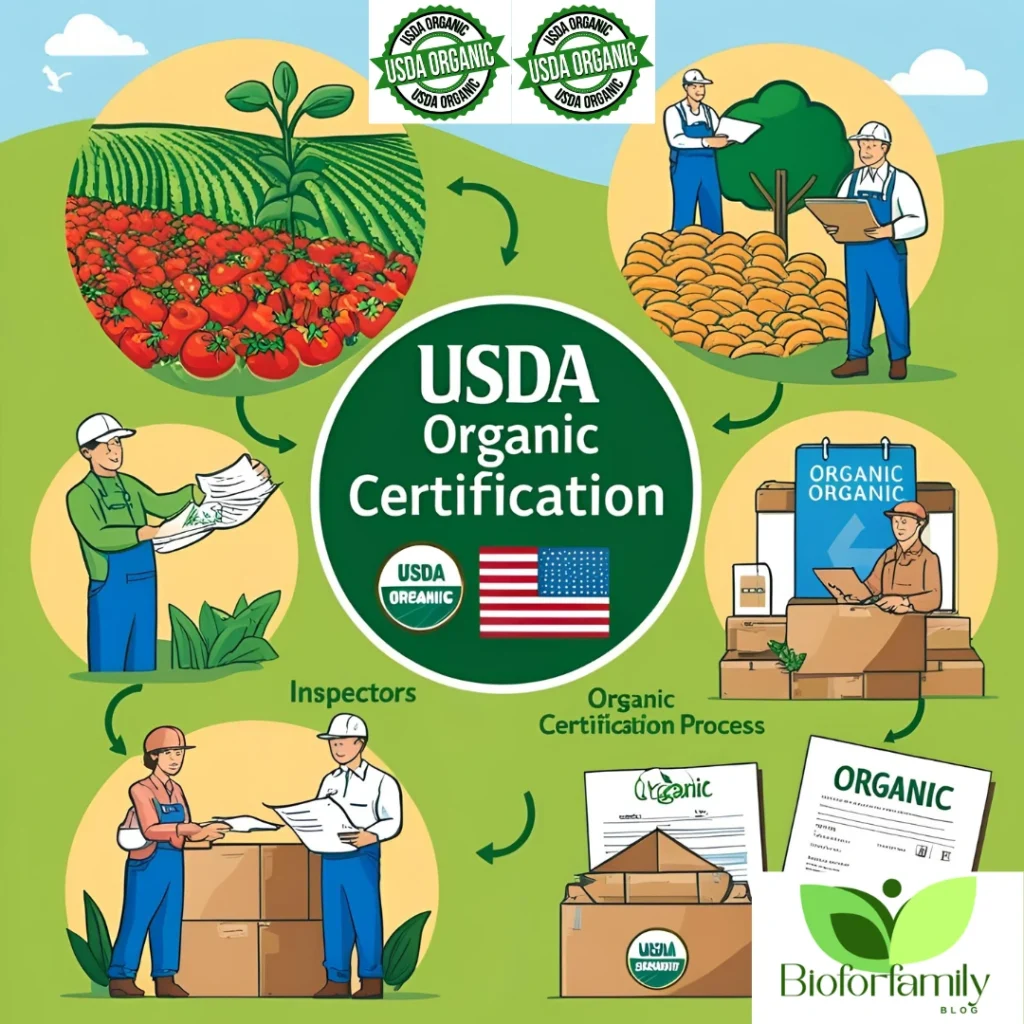
To qualify for USDA Organic certification, farms and producers must meet strict and detailed requirements. Specifically, these standards cover every aspect of the production process, ensuring that practices from soil health to animal welfare and food handling align with core organic principles. To facilitate understanding, the USDA organizes its standards into three primary categories: crops, livestock, and processed products.
1. Organic Crop Production Standards
USDA standards for crops focus on maintaining healthy soil and protecting the environment. Key requirements include:
- No synthetic fertilizers or prohibited pesticides
- No genetically modified organisms (GMOs)
- Use of crop rotation and cover crops to maintain soil fertility
- Natural pest and weed control methods, such as beneficial insects and mulching
These practices are designed to promote biodiversity, reduce pollution, and keep ecosystems in balance.
2. Organic Livestock Standards
Raising animals organically requires a commitment to both health and ethical treatment. Livestock standards include:
- 100% organic feed with no antibiotics, hormones, or animal by-products
- Access to the outdoors, including pasture for ruminants like cows and sheep
- Living conditions that support natural behaviors, like space to roam and clean bedding
- Preventative health care practices, such as clean housing and rotational grazing
Animal welfare is a key focus of organic certification, ensuring humane and responsible treatment from birth to slaughter.
3. Standards for Processed Organic Products
Processed foods can be certified organic too, but only if they meet strict criteria. Requirements include:
- At least 95% organic ingredients for the product to carry the USDA Organic seal
- No artificial preservatives, colors, or flavors
- Approved handling and processing methods, with no contamination from non-organic substances
- Proper labeling to reflect the organic content and certification status
This ensures that the organic label on your favorite snacks, cereals, or beverages truly reflects their quality and sourcing.
4. Traceability and Recordkeeping
Across all categories, USDA organic standards require meticulous recordkeeping. Farms and processors must document every step, from seed sourcing and soil amendments to feed records and processing logs. These records are reviewed during inspections to confirm compliance and traceability.
USDA Organic Labeling and What It Means
Seeing the USDA Organic seal on a product can influence your decision to buy—but do you know what that label actually guarantees? The USDA has established clear labeling categories to help consumers understand how organic a product really is. These labels are not just for marketing; they reflect strict certification and compliance standards.
1. “100% Organic” Label
To begin with, products labeled as “100% Organic” must contain only certified organic ingredients and approved processing aids (excluding water and salt). This is the strictest organic labeling category.
- No synthetic additives are allowed at any stage of production.
- Every ingredient must be certified organic, with no exceptions.
- As a result, these products qualify to carry the USDA Organic seal on their packaging.
In short, this label offers the highest level of assurance to consumers that the product is entirely organic, meeting all USDA standards without compromise.
2. “Organic” Label (95% Rule)
Product labeled as “Organic” must contain at least 95% certified organic ingredients.
- The remaining 5% must be on the USDA’s approved National List
- Still eligible to display the USDA Organic seal
- Common in packaged foods with minor non-organic elements that are hard to source organically
This is the most common label in organic processed goods.
3. “Made with Organic [Ingredients]”
Products labeled as “Made with Organic [ingredient]” must contain at least 70% organic ingredients.
- Cannot display the USDA Organic seal
- The specific organic ingredients can be listed on the front label (e.g., “Made with organic oats and honey”)
- Still subject to USDA oversight and certification
This label is useful for consumers who want some level of organic content but don’t require full certification.
4. Understanding Misleading or Unregulated Labels
It’s important to note that not all labels claiming to be “natural,” “eco-friendly,” or “non-GMO” are created equal. While these terms may sound appealing, they often lack the regulatory backing that gives the USDA Organic seal its credibility.
- First, these claims are not regulated by the USDA, meaning there are no consistent standards or certification processes behind them.
- Second, such labels may suggest health benefits or environmental responsibility—but without verified or enforced practices.
- As a result, they can mislead consumers into believing a product is organic when it actually isn’t.
To be certain you’re getting a truly organic product, look for the USDA Organic seal, which is only allowed on products that are certified by an Accredited Certifying Agent (ACA) and fully comply with USDA organic standards.